


Do You Really Need a Human Translator for Medical Documents? Here's the Truth

Updated: Mar 24
I'll cut to the chase: yes, you absolutely need a human translator for medical documents. And no, AI translation, no matter how sophisticated, isn't going to cut it when patient safety, regulatory compliance, or clinical outcomes are on the line.
I know what you're thinking. Machine translation has come a long way. It's fast, it's cheap, and it's tempting to click "translate" on Google and call it a day. But here's what most people don't realize until it's too late: medical translation isn't just about converting words from one language to another. It's about preserving meaning, context, and precision in a field where a single mistranslation can have life-or-death consequences.
Let me walk you through why human expertise isn't optional in healthcare and what happens when organizations try to cut corners.
The Stakes Are Higher Than You Think
You shouldn't have to gamble with patient safety or regulatory compliance because someone thought machine translation was "good enough." But it happens more often than you'd expect.
Medical documents aren't like marketing brochures or casual emails. I'm talking about the materials that directly shape care decisions, legal consent, and regulatory outcomes—patient records that inform treatment, informed consent forms where ethical clarity is non-negotiable, clinical trial documentation that must satisfy multi-country requirements, research reports where terminology consistency impacts scientific validity, and drug labels or instructions for use where a dosage misunderstanding can be fatal.

When a physician in Quebec reads a translated patient history from an English-speaking hospital, they need to trust that "hypertension" wasn't rendered as "high blood pressure" in one section and something else in another. They need to know that medication dosages are accurate, that contraindications are clearly stated, and that nothing was lost—or worse, distorted—in translation.
This isn't theoretical. Section 1557 of the Affordable Care Act and Title VI of the Civil Rights Act require healthcare organizations receiving federal funding to provide accurate translations for limited English proficient individuals. HIPAA adds another layer, demanding that patient information be maintained in confidentiality and accuracy across languages. Non-compliance doesn't just mean bad outcomes for patients: it means investigations, corrective action plans, and potential loss of federal funding.
Why 98% Accuracy Isn't Good Enough
Here's where the AI conversation gets uncomfortable: most machine translation systems boast accuracy rates around 95-98%. That sounds impressive until you do the math.
If a 500-word medical document is translated at 98% accuracy, that's 10 words that are wrong, ambiguous, or mistranslated. Now imagine those 10 words include a medication dosage, a critical contraindication, or a procedural instruction. Suddenly, that 98% doesn't feel so reassuring.
In medical translation, we're not aiming for 98% or even 99%. We're aiming for 100% clarity because anything less introduces risk.
Machine translation struggles when meaning depends on context—like whether “dose” refers to a single administration or a cumulative amount. It also routinely misses regional medical conventions because French medical terminology can vary significantly between France, Quebec, and francophone Africa. Add in nuanced phrasing where implication matters as much as literal wording, plus regulatory language that must match country-specific health authority expectations, and you’re left with gaps that simply aren’t acceptable when the stakes are already high.
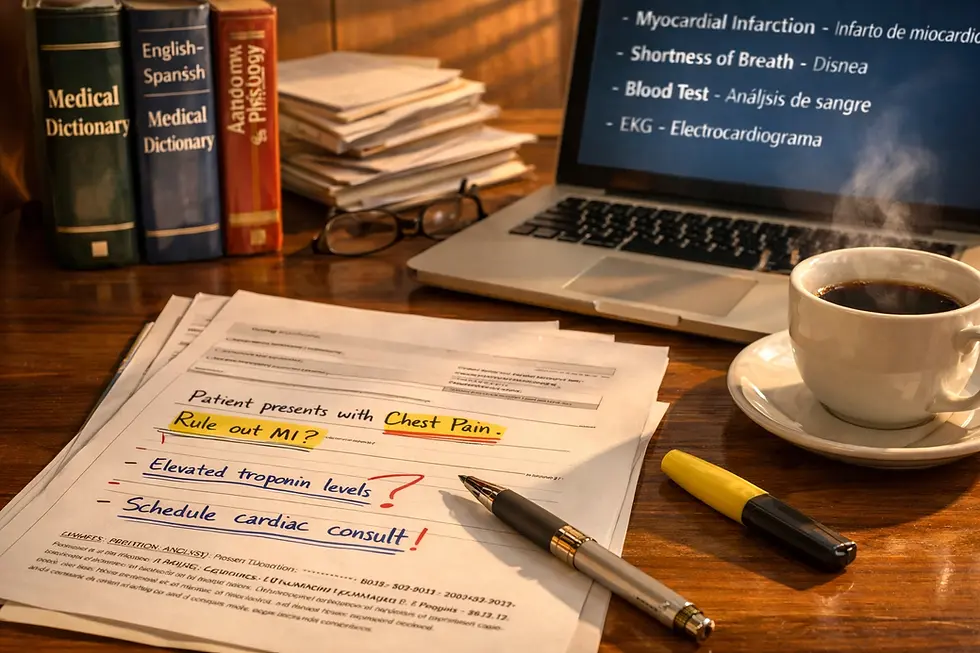
A human translator with medical expertise doesn't just know both languages: they understand the medical concepts, recognize when terminology is being used incorrectly in the source document, and know how to adapt content for specific regulatory frameworks. That's not something an algorithm can replicate, no matter how many datasets it's trained on.
What Human Translators Bring to the Table
When I work on medical documents, I bring more than linguistic fluency—I bring the kind of judgment that protects patients and keeps organizations compliant.
Subject matter expertise you can rely on
I understand medical terminology, pharmacology, anatomy, and clinical procedures. If a source document contains an error or inconsistency, I catch it. If terminology needs to align with a specific regulatory body's standards, I know exactly which glossaries and references to use.
Cultural and regulatory literacy that prevents costly missteps
Medical translation isn't just about language—it's about how healthcare systems operate in different regions. A consent form translated for use in France needs to reflect French medical ethics standards and legal requirements, not just French words. Instructions for use must comply with local Ministry of Health packaging regulations.
Consistency and quality control across every page
I establish terminology databases and style guides so that every instance of "myocardial infarction" is translated the same way throughout a 200-page clinical trial document. I cross-reference previous translations, maintain glossaries, and run rigorous quality checks that catch errors before they reach patients or regulators.
Clear accountability, not a black box
When you work with a professional human translator, there’s someone you can hold accountable. If a question comes up, I explain my translation choices. If an update is needed, I will revise with full context and consistency. Machine translation offers none of that.

How I Approach Medical Translation at Meliora
You deserve more than a generic translation service that treats medical documents like any other text. Here’s how it works when you bring your medical translation to me at Meliora Translation Services—precision first, compliance built in, and patient safety treated as the priority it is.
Specialized expertise from the start
I work with translators who have backgrounds in healthcare, life sciences, or medical translation certification. This isn’t a side gig—it’s focused, professional expertise applied to documents that can’t afford guesswork.
Terminology management that keeps everything consistent
For every project, I establish or reference terminology databases so your language stays precise and uniform across documents. Whether it’s patient records, research reports, or consent forms, I keep key terms consistent and defensible from beginning to end.
Regulatory alignment for your target market
I research and apply the standards that matter where your documents will be used. If you’re submitting materials to Health Canada, the FDA, or the European Medicines Agency, I make sure the translation matches their expectations—so you’re not scrambling to fix issues at the last minute.
Multi-layer review that catches what others miss
Medical documents go through multiple rounds of review—translation, editing, proofreading, and final quality checks. Nothing goes out the door without at least two sets of expert eyes confirming accuracy.
Confidentiality and security that stays tight
HIPAA compliance isn’t optional. I handle medical documents with strict confidentiality protocols, secure file transfers, and non-disclosure agreements. Your data stays secure, period.
I also collaborate with healthcare institutions, pharmaceutical companies, research organizations, and legal firms that need cross-border medical documentation. Whether you're managing multilingual patient care, conducting international clinical trials, or navigating immigration medical requirements, I deliver translations that meet the highest standards of accuracy and compliance.
The Bottom Line
Machine translation has its place: it's great for getting the gist of an article or translating non-critical content quickly. But when it comes to medical documents, "good enough" isn't in the vocabulary.
You need human expertise. You need someone who understands the stakes, the terminology, and the regulatory landscape. You need precision, accountability, and a translator who won't just convert words but will preserve meaning and ensure patient safety.
At Meliora Translation Services, I specialize in exactly that. If you're dealing with patient records, research reports, consent forms, or any other medical documentation that demands accuracy, let's talk. I'll make sure your translations meet the standards your patients and regulatory bodies expect without cutting corners or taking unnecessary risks.
Because in healthcare, clarity isn't just important. It's everything.


Comments